Head Office
Suite 309, 1st Floor, Annex 1, Kisozi Complex, Kyagwe Road, Nakasero – Kampala
Email
info@deedmicrofinance.com
Phone
+256414599959
Work Hours
Monday to Friday: 8AM - 5PM
Head Office
Suite 309, 1st Floor, Annex 1, Kisozi Complex, Kyagwe Road, Nakasero – Kampala
Email
info@deedmicrofinance.com
Phone
+256414599959
Work Hours
Monday to Friday: 8AM - 5PM
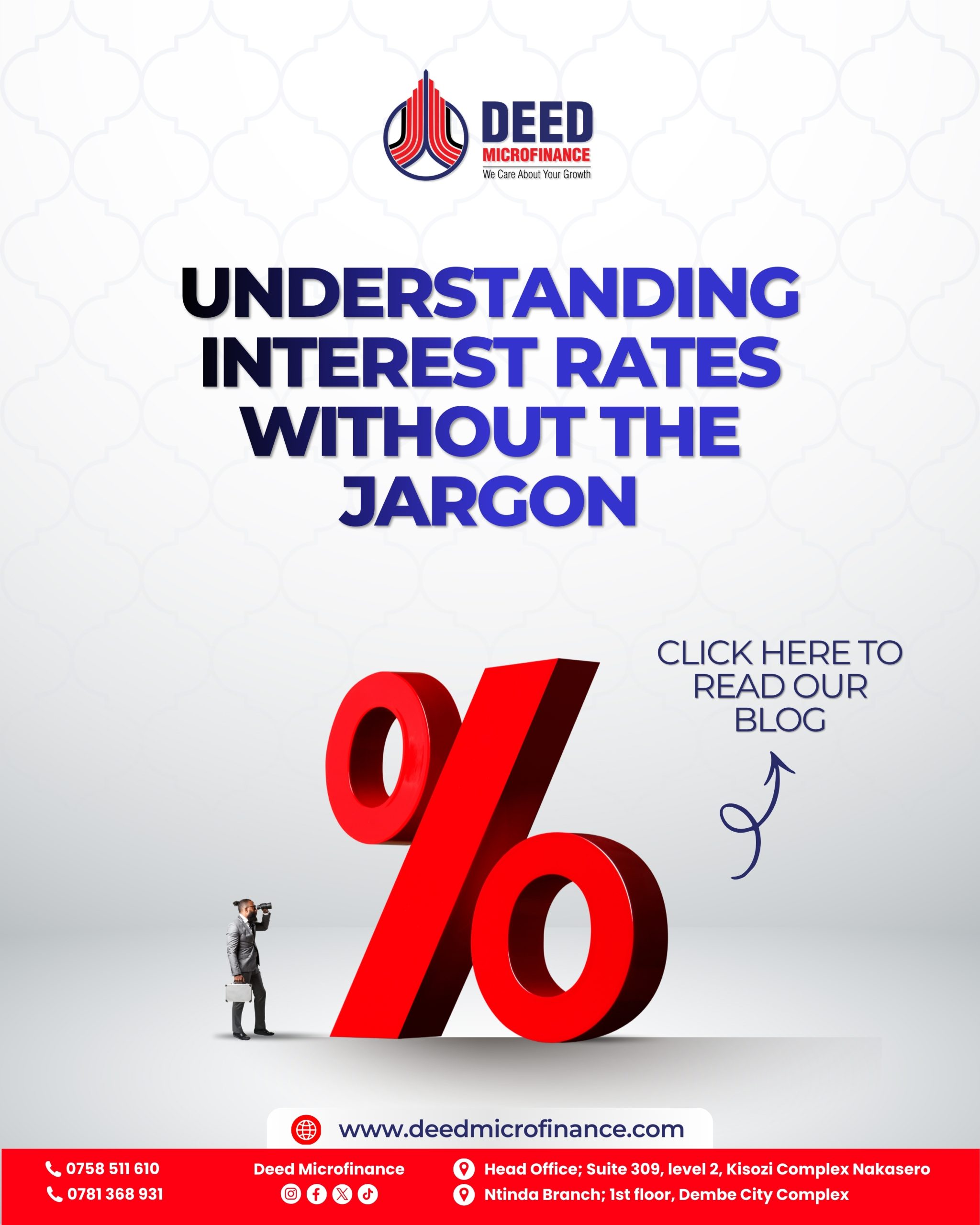
When it comes to loans, one of the most confusing things for many people is the interest rate. Banks, microfinance institutions, and lenders throw around percentages, monthly rates, and APRs, and suddenly borrowing feels like a math exam.
But it doesn’t have to be complicated. Understanding interest rates is really about knowing how much extra you pay for borrowing money and why it matters.
At its simplest, an interest rate is the cost of borrowing money. Think of it as a “thank you fee” you pay to the lender for letting you use their money today instead of later.
For example:
That’s it, nothing mysterious.
Not all loans have the same rate, and that’s okay. Rates vary because lenders consider things like:
So a higher interest rate doesn’t mean the lender is being unfair, it’s often a reflection of the risk and timing involved.
Think of borrowing money like hopping onto a ride. With fixed rates, it’s like a calm train ride, steady, predictable, and you know exactly where you’ll end up. Your monthly payments stay the same, so planning is easy. Take for example if you borrow UGX 1,000,000 at 10% interest for one year
Interest = UGX 1,000,000×10%= UGX 100,000
Total payment after 1 year:
Principal + Interest = 1,000,000+100,000 =1,100,000
With variable rates, it’s more like a rollercoaster, exciting but unpredictable. Your payments can go up or down depending on market changes, so you need to be prepared for some bumps along the way.
Simplest example: monthly compounding:
Loan: 1,000,000 UGX
Monthly interest rate: 10% ÷ 12 = 0.833% ( UGX 8330)
| Month | Balance UGX | Interest UGX | Payment UGX | New balance UGX |
| 1 | 1,000,000 | 8330 | 100,000 | 908,330 |
| 2 | 908,330 | 7,569 | 100,000 | 815,899 |
The total interest depends on how much you pay each month and when, so it is variable.
Understanding the difference helps you choose the ride that fits your comfort level, steady and safe, or flexible but unpredictable.
By understanding how interest works, you can make borrowing decisions that are intentional, affordable, and stress-free.
Interest rates don’t have to be scary. They are simply the cost of using money now instead of later. By breaking them down into plain language and understanding the total cost, you take the mystery out of loans and gain control over your financial decisions.
Interest is not a punishment, it’s a price for opportunity. The more you understand it, the smarter your borrowing choices become.