Head Office
Suite 309, 1st Floor, Annex 1, Kisozi Complex, Kyagwe Road, Nakasero – Kampala
Email
info@deedmicrofinance.com
Phone
+256414599959
Work Hours
Monday to Friday: 8AM - 5PM
Head Office
Suite 309, 1st Floor, Annex 1, Kisozi Complex, Kyagwe Road, Nakasero – Kampala
Email
info@deedmicrofinance.com
Phone
+256414599959
Work Hours
Monday to Friday: 8AM - 5PM
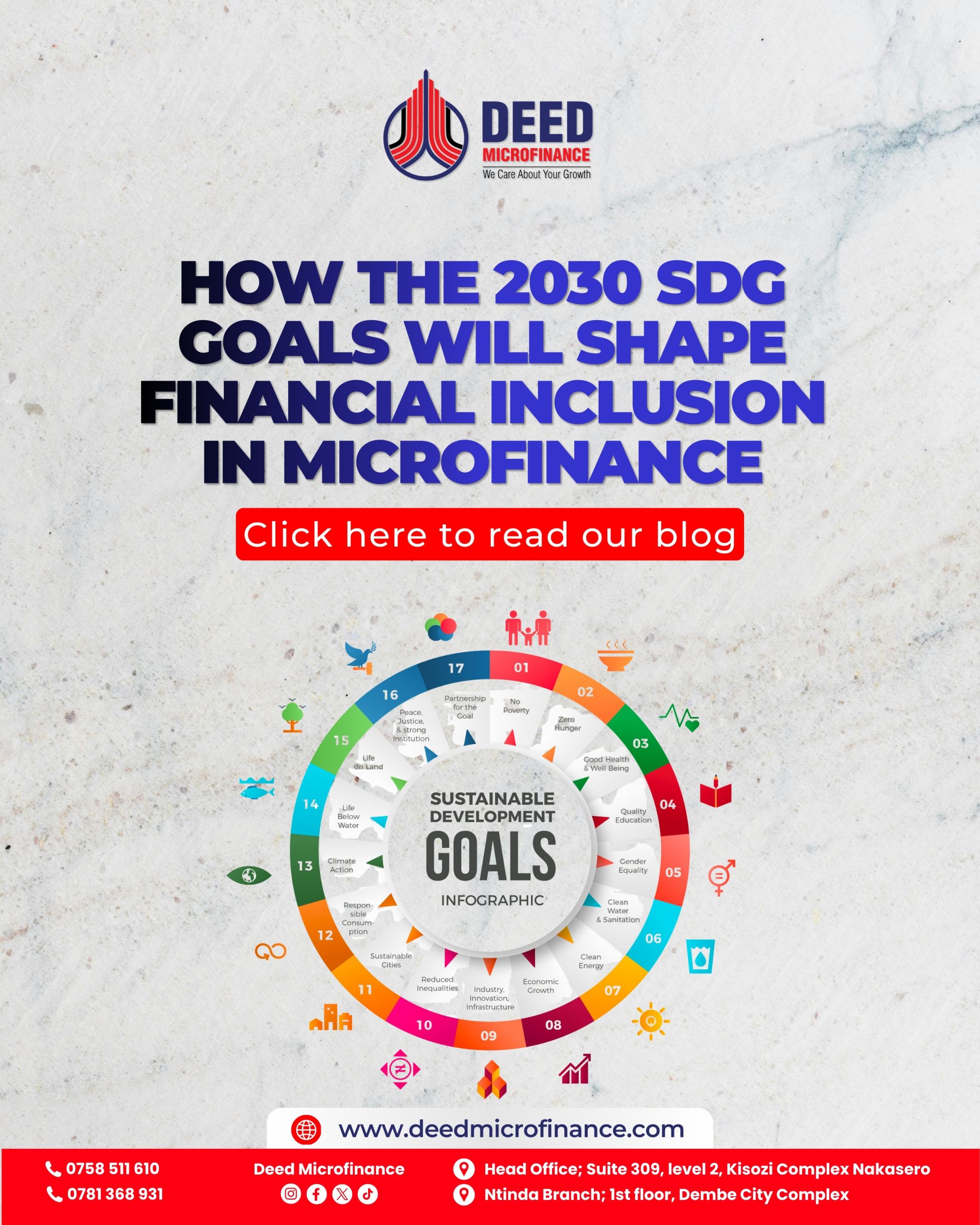
The 2030 Sustainable Development Goals (SDGs) aim to end poverty and reduce inequalities worldwide. For millions of people living without access to formal financial services, these goals are more than aspirations, they are a roadmap for opportunity.
Microfinance institutions (MFIs) have long been at the forefront of financial inclusion, providing small loans, savings options, and financial literacy programs to underserved communities. As the SDGs drive global development agendas, the microfinance sector is poised to play an even greater role in lifting people out of poverty and reducing inequalities.
Despite global commitments to end poverty and reduce inequality by 2030, progress remains off track. Fewer than one-third of countries are on course to achieve SDG 1 and SDG 10, and nearly 800 million people could still be living in extreme poverty by the end of the decade. Income gaps continue to widen, especially among informal and low-income earners. This growing gap between ambition and reality underscores an urgent truth, financial inclusion is not optional. Increasing access to credit, savings, and affordable loans through microfinance is essential to ensure no one is left behind. Read statistics here.
No poverty (SDG 1) and reduced inequalities (SDG 10) are at the core of microfinance. By 2030, MFIs are expected to significantly expand their reach to include the hardest to reach populations, rural households, informal workers, and marginalized groups.
Access to credit and loans empowers people to:
By providing these financial tools responsibly, microfinance transforms lives, creating real opportunities to escape poverty. Loans are no longer just money, they are a lifeline to stability, self-reliance, and growth.
The SDG agenda encourages innovation to reach more people faster. Mobile banking, digital wallets, and innovative microloan products are making it possible for MFIs to serve rural or underserved communities efficiently. These innovations reduce costs, increase transparency, and give clients greater control over their finances helping to close the inequality gap.
Financial inclusion under SDG 1 and SDG 10 isn’t just about statistics, it’s about measurable
social impact:Families move out of poverty and invest in their futures.
Microfinance institutions, guided by the SDG framework, are increasingly expected to track and report these outcomes, ensuring that credit is not just available, but truly empowering.
The 2030 SDG goals put financial inclusion at the center of poverty reduction and inequality. For microfinance, this is a call to expand reach, innovate, and focus on real impact. By connecting underserved populations to loans, savings, and financial education, MFIs are not just providing credit, they are providing a path out of poverty, reducing inequality, and building resilient communities for the future.


Well written article.
Thank you